

Disability Pride Month 2026: An Overview and the Truth About Common Myths
What is Disability Pride Month?
Disability Pride Month is observed every July to celebrate the disability community, recognize its many contributions, and promote awareness, inclusion, and equal rights. It is also an opportunity to acknowledge the progress that has been made while recognizing that barriers to accessibility and equality still exist.
“The Arc’s National Council of Self-Advocates selected this year’s Disability Pride Month theme, ‘The World Works Better With Us.'” The theme highlights how inclusion, respect, and accessibility strengthen communities and benefit everyone.
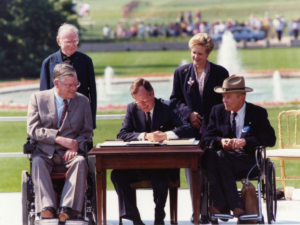
Disability Pride Month has officially taken place every July since 2015 in commemoration of the Americans with Disabilities Act (ADA), which President George H. W. Bush signed into law on July 26, 1990. The ADA is a landmark civil rights law that prohibits discrimination against people with disabilities and guarantees equal rights and opportunities in areas such as employment, transportation, public services, and public accommodations.
A key purpose of Disability Pride Month is to increase awareness of the disability community while encouraging people to become stronger allies. This includes learning about disabilities, understanding the diverse experiences of people with disabilities, challenging common misconceptions, and advocating for greater accessibility and inclusion—even if you are not part of the disability community.
Debunking Common Myths about Disabilities
Despite growing awareness, stigma and misconceptions about disabilities and the disability community remain widespread, often contributing to ableism.
Ableism is a form of discrimination that favors non-disabled individuals and devalues people with disabilities through attitudes, actions, or systems that assume disability is inferior. Ableism can appear in many forms, including excluding individuals with disabilities, failing to provide ADA accommodations, and questioning whether someone’s disability is real or severe enough.
Combating misinformation and ableism begins with education and a willingness to engage in truthful, accurate conversations about disability and inclusion.
Myth: All disabilities are visible
When many people hear the word “disabled,” they often think of a physical disability or the universal wheelchair symbol. However, it is important to recognize that not all disabilities are physical, visible, or accompanied by an obvious visual indicator. Many disabilities are invisible, and appearance alone cannot always reveal a person’s disability.
Many people with invisible disabilities struggle in silence because they fear that others will not believe them or will tell them that they are not truly disabled. Conditions such as mental health disorders, chronic pain, autoimmune diseases, and other non-visible disabilities can significantly affect a person’s daily life, even if their symptoms are not apparent to others. Although these disabilities may not be immediately visible, they can have a profound impact on an individual’s ability to work, maintain relationships, and participate in everyday activities.
To learn more about unseen disabilities, check out our blog post about the topic.
Myth: Reasonable accommodations at work are overly expensive and difficult.
Most accommodations cost between $0-$500. A report prepared by the Job Accommodation Network (JAN) for the Department of Labor’s Office of Disability Employment Policy surveyed 26,028 employers from January 2019- December 2024.
The report stated that 61% of accommodations cost employers nothing, and 33% of accommodations have a one-time average cost of $300. Moreover, there are even tax incentives available to help employers cover the costs of accommodations.
Additionally, the impact of accommodations improves employee productivity, overall employee morale, and employee retention. The data backs this up — 66% of employers reported that the accommodations they provided were very or extremely helpful in enabling employees to perform their jobs.
Myth: People with disabilities don’t want to work
There’s a common misconception that often stems from a lack of understanding of the disability community, that people with disabilities don’t want to work. This simply isn’t true.
People with disabilities experience unemployment at rates more than twice as high as those without disabilities. However, it is important to understand that this does not mean they do not want to work. Many people with disabilities want to work but often still face barriers.
Unfortunately, many employers have preconceived notions or biases about disability, capability, and workplace accessibility. Some also mistakenly believe that providing accommodation is too costly or burdensome.
Reasonable accommodations help ensure that qualified individuals with disabilities have equal access to employment opportunities. These accommodations do not exist to provide an advantage, but rather to create a level playing field by giving employees with disabilities the same opportunities and access as everyone else.
All people –disabled or not disabled– have different abilities, strengths, and talents. People with disabilities bring unique skills and perspectives to the workplace and their communities. In fact, many individuals with disabilities demonstrate strong problem-solving abilities, creativity, and resilience, because navigating a world full of barriers not built with their needs in mind often strengthens those skills.
Common Reasonable Accommodations in the Workplace Under the ADA
There are many types of reasonable accommodations, depending on an individual’s specific needs. Workplace accommodations are protected under the ADA, which applies to employers with 15 or more employees. These accommodations help ensure that qualified individuals with disabilities have equal access to employment opportunities.
The ADA defines a reasonable accommodation as a modification or accommodation that does not cause “undue hardship” on an employer. Undue hardship is defined as “an action requiring significant difficulty or expense when an employer evaluates factors such as an organization’s size, financial resources, and the nature and structure of its operation.”
Example 1: An employee with chronic back pain has difficulty sitting for long periods of time.

Accommodation: The employer provided an ergonomic workstation for the employee with specialized chair and a sit/ stand desk
Cost: $400
Example 2: An employee with a sensory processing disorder has trouble concentrating because of auditory distractions.
Accommodation: The employer provides a noise cancelling headset to the employee
Cost: $150
Example 3: An employee with Crohn’s disease needs to take frequent breaks and has issues commuting every day.
Accommodation: The employer gives the employee the option to telework and provides at home equipment (monitor, keyboard, mouse)
Cost: Nothing (the equipment is provided to all employees)
Example 4: An employee who uses a wheelchair has difficulty moving freely in the office space.
Accommodation: The workspace is rearranged for accessibility and mobility.
Cost: Nothing
These are just a few examples of workplace accommodations. To request an accommodation, you can contact your Human Resources department or speak with your supervisor. While there is no specific legal requirement for how a request must be made, it is generally best to submit the request in writing, such as through an email, to ensure clear communication and proper documentation for all parties involved.
For additional information about workplace accommodations, examples, and how to request them, check out the ADA’s National Network and the JAN website.
Navigating Disability Benefits
Many individuals with disabilities continue to work successfully. However, when a medical condition or disability becomes severe enough to prevent you from working, it is important to understand the options available to you. Coping with a life-changing condition can be challenging, and Social Security Disability Insurance (SSDI) benefits may provide financial stability.
SSDI is a government program regulated by the Social Security Administration (SSA). There are strict requirements to qualify for benefits:
- You must be unable to work at Substantial Gainful Activity (SGA) levels because of a disability for at least 12 consecutive months.
- You must meet the SSA’s definition of disabled.
- You must have paid into the program through FICA payroll taxes and earned enough work credits.
- You must have sufficient medical evidence that proves you are unable to work.
If you have limited income and financial resources, you may also qualify for Supplemental Security Income (SSI) benefits. Like SSDI, SSI is administered by the SSA, but it has different eligibility requirements. SSI is a needs-based program that provides financial assistance to elderly, blind, or disabled individuals with limited income and resources. To qualify for SSI benefits, applicants must meet strict limits on their assets and financial resources, as eligibility is based primarily on financial need.
- You must have no more than $2,000 for an individual and $3,000 for a couple
- You must not own more than one home
- You must not own more than one car
- You must meet the SSA’s definition of disabled
The SSA will also count any other assets you have like stocks or property when determining your eligibility for SSI benefits.
To apply for benefits, you can submit an application by mail, visit a regional SSA office, or online by creating a “my Social Security” account.
Disability Lawyers
SSDI and SSI benefits are a crucial lifeline that have helped millions of Americans who are unable to work due to disability or medical condition. The application process can be complicated and time-consuming. The extensive paperwork, medical documentation, and strict eligibility requirements can make it easy for applicants to submit incomplete information or make mistakes that may delay or impact their claim.
Attorneys who specialize in disability law can help guide applicants through the process and provide representation throughout their claim. In most SSDI and SSI cases, attorneys work on a contingency fee basis, meaning there are no upfront costs, and they only receive payment if the SSA approves the claim. Attorney fees are paid directly by the SSA and currently, attorney fees are limited to 25% of past-due benefits, capped at $9,200.
Fierce Advocacy
When it comes to finding a disability lawyer, Nyman Turkish has more than 40 years of experience helping individuals pursue the disability benefits they deserve. As a family-founded and operated firm, we are committed to providing compassionate representation and personalized support throughout the claims process. Our Firm also maintains an approval rate that is significantly higher than the national average.
At Nyman Turkish, our experienced case managers, legal assistants, and attorneys work together to help clients navigate the Social Security Disability process with confidence. We treat every client with respect and are dedicated to delivering knowledgeable, compassionate legal representation every step of the way.
If you are considering applying for benefits or have applied and need help, visit our website or call 877-529-4773 for a FREE case review.
