

What Happens After My SSDI Claim Is Approved?
After navigating the process of applying for Social Security Disability benefits and waiting months for a decision, receiving an approval can feel like a major relief. However, you may find yourself wondering when you will get your benefits and, “What happens after my SSDI claim is approved?“
While the most difficult part of the process may be behind you, there are still important things to know about what happens next after the Social Security Administration (SSA) approves you.
Important Mail
You will receive official notification of your approval from the SSA. The type and timing of the notice you receive depends on the stage of your claim and the decision.
For Initial and Reconsideration Decisions:
Your Notice of Award serves as your approval letter. It will state whether your decision is fully favorable or partially favorable, and will explain the details of your benefits.
For Hearing-Level Decisions:
If an Administrative Law Judge (ALJ) approves your claim, you will first receive a Written Notice of Decision explaining the ALJ’s decision. This is followed by a Notice of Award with details about your benefits.
You may be able to view these documents sooner through your my Social Security account.
Types of Letters You May Receive:
- Written Notice of Decision — Officially states the decision on your claim. At the hearing level, this notice comes from the ALJ and is sent before the Notice of Award.
- Notice of Award — Explains how much you will receive in monthly benefits, when your benefits will begin, and any retroactive back pay you are owed. For approvals at the initial or reconsideration stage, this is your decision letter.
When will I receive my benefits?
The general window is 30-90 days from the date of your Notice of Award. However, this timeframe can vary significantly depending on the office processing your payment, and it can be delayed further if Social Security is waiting on documentation from you or needs to verify other benefits you may have received during this process.
You will receive your monthly benefit on the specific Wednesday depending on your date of birth.
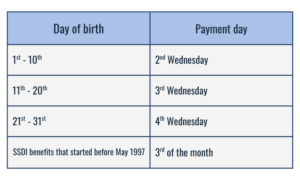
The SSA now issues SSDI payments electronically through direct deposit or a government-issued debit card. Setting up electronic payments is important to help avoid any delays with your monthly payments.
Understanding the mandatory five-month waiting period
Regardless of whether you receive a partially or fully favorable decision, the SSA requires a five-month mandatory waiting period before SSDI benefits can begin. This means you will not receive benefits for the first five full calendar months after your official disability onset date. Your first payable month will be the sixth full calendar month after your disability began.
Example:
The SSA determines that your disability began on February 15. The five-month waiting period would be March, April, May, June, and July. Your first month eligible to receive SSDI benefits would be August, the sixth full calendar month after your disability onset date.
Fully vs. partially favorable approval
A fully favorable decision means Social Security agrees you meet its requirements for disability and agrees your disability began on the alleged onset date (AOD) — the date you listed on your application as the day you became unable to work. Because nothing about your claim changed, the SSA figures your benefits from that date under Social Security’s rules, which is the most your claim can pay based on the information submitted with your application.
A partially favorable decision means Social Security agrees you meet its requirements for disability and approves your claim for benefits, but it found that your disability began on a later date than the alleged onset date on your application. You remain approved. The difference is the onset date Social Security established, which determines how far back the SSA figures your benefits and, in turn, the amount of past-due benefits you receive.
If you disagree with the onset date, you have the right to appeal within 60 days. A successful appeal would move your onset date earlier and increase the past-due benefits the SSA owes you. There is risk as well: on appeal, the SSA is not limited to reviewing the onset date, so it can revisit the finding that you are disabled, and could ultimately deny the claim.
Because the appeals process can be complex, it is highly recommended that you consult with an experienced disability attorney. An attorney can help you evaluate whether an appeal is in your best interest, explain your options, handle the necessary paperwork and filings, and represent you throughout the appeals process.
Fierce Advocacy
You deserve to breathe a sigh of relief after the SSA approves your Social Security Disability claim, but you may still be wondering, “What happens after my SSDI claim is approved?” At Nyman Turkish, our experienced disability attorneys and case managers are here to guide you through every step of the Social Security Disability process—even after approval.
With an approval rate significantly higher than the national average, we’ve built a reputation for trusted representation and proven results. We handle every case with the care, compassion, and attention it deserves.
If you need help with your disability claim, visit our website or call (877) 529-4773 to speak with a member of our team.
