

The Grid Rules
When you apply for benefits, you may wonder how the Social Security Administration (SSA) determines eligibility. One part of this determination is the Sequential Evaluation Process, a five-step review used to decide whether an applicant is disabled.
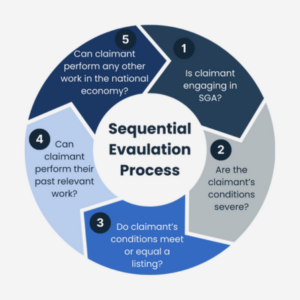
This analysis determines whether an individual is disabled. If, at any step, a determination is made that the individual is not disabled, the analysis stops. However, if Step 3 is not met, the evaluation continues to Step 4.
In Step 4, the SSA uses the medical-vocational guidelines—also known as the Grid Rules—to determine an applicant’s eligibility for Social Security Disability Insurance (SSDI) benefits.
The following factors are used to determine if you are disabled using the Grid Rules:
- Age
- Education level
- Previous work experience
- Transferrable skills
- Residual functional capacity (RFC)
You may hear the term ‘grid out’ used. This means the individual would be determined disabled based on these factors, according to the rules the SSA uses.
The term “grid” refers to the table or chart created by comparing these variables.
Taking a Closer Look at Each Grid Factor
Your Age
The SSA uses age groups to further categorize your age and how that affects your ability to work or transfer into a new job.
- Younger (18 through 49)
- Approaching advanced age (50 to 54)
- Advanced age (55 and over)
- Approaching retirement age (60 and over)
Education Level
The SSA factors education level to see how well you could switch careers. Typically, the higher your education level the more job options you have available.
- Illiteracy (cannot read or write, the SSA usually considers an individual literate if they have completed 4th grade)
- Marginal Education (6th grade or less)
- Limited Education (7th through 11th grade completed)
- High School Education and Above (12th grade and above completed)
- Equivalent to a high school degree is passing General Educational Development (GED) exam, High School Equivalency Test (HiSET), or Test Assessing Secondary Completion (TASC).
There are additional details with each education level, like job training for direct entry into specific skilled work.
There are also notes and exceptions to these 4 categories explained on the SSA’s website.
Unskilled, Semiskilled, and Skilled Past Relevant Work
The SSA evaluates your past work from five years prior to the date of adjudication—or, if your Date Last Insured (DLI) has expired, from the five years prior to the DLI– as documented in your application or earnings record, to assign a skill level to each job.
Unskilled work
Jobs that you can learn typically in 30 days.
- Janitor
- Parking lot attendant
- Laborer
- Fast food worker
Semiskilled work
Jobs that are more complex but do not require as much training or education as skilled work.
- Bartender
- Flight attendant
- Security guard
Skilled work
These are jobs that require a higher education level and training.
- Healthcare professional
- Electrician
- Teacher
Transferable Skills
A contracted impartial vocational expert will assess if you have transferable skills and determine what, if any, a person with your residual functional capacity might be able to do.
If your past work was skilled or semiskilled, the SSA will determine whether any of the skills needed in past jobs can be transferred and used in a new profession.
Transferability is likely if the other job requires the same or lesser skills. For example, operating machinery, data entry, leadership, and communication skills are sometimes skills that are considered transferable.
If a skill or technique that was needed in a previous role can be applied to a different role, then that skill can be considered transferable. If you have transferrable skills, it may be harder for the SSA to find you disabled and be approved for benefits.
Residual Functional Capacity (RFC)
Your remaining capacity to work with your disability is what the SSA calls RFC. RFC measures a person’s ability to sit, stand, lift and carry weight, push and pull, perform postural activities, and manage mental limitations. It represents the maximum level of work an individual can perform given their impairment. That capacity or level of exertion is grouped into 5 categories.
There are five types of work:
- Sedentary work — office-based work that primarily involves sitting at a desk for 6–8 hours per day and requires lifting no more than 10 pounds.
- Light work — work that involves a combination of sitting, standing, or walking for 6–8 hours per day and requires lifting up to 20 pounds, such as jobs as a housecleaner or janitor.
- Medium work — work such as nursing or patient care, which typically requires lifting up to 50 pounds and standing or walking for 6–8 hours per day.
- Heavy work — skilled construction-type work that requires the ability to lift up to 100 pounds and stand or walk for 6–8 hours per day.
- Very heavy work — unskilled construction-type work that requires lifting more than 100 pounds and standing or walking for 6–8 hours per day.
Once the SSA determines your RFC, they compare it with the other corresponding factors mentioned above –age, education, and previous work/transferable skills– using a table or grid.
Below is an example of the grid the SSA uses:
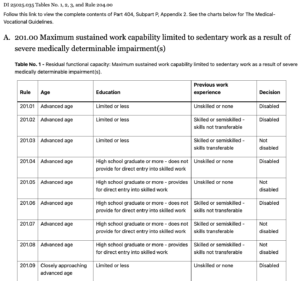
In some cases, even if the Grid Rules would determine an individual not disabled, there are other factors that still get them approved for benefits. Typically, mental health conditions are not applied using the grid method. Additionally, having multiple impairments can get you approved for benefits.
SSDI Lawyer
Understanding the grids can be confusing and complex. Applying for benefits can be hard; it requires lots of paperwork, documentation, and records. All while dealing with a significant impairment that affects your daily life, it can be overwhelming to do it alone.
It is highly recommended that if you are applying for SSDI benefits, you hire a disability lawyer. An experienced and knowledgeable disability attorney can take care of filing paperwork, reviewing your application for potential errors, and schedule or file for appeals if necessary.
Choosing the right disability lawyer or firm is important not only for the approval of your benefits application, but also for your overall well-being throughout the process.
Fierce Advocacy
At Nyman Turkish, we understand how stressful this time can be. Our Firm treats every client with care, compassion, and understanding throughout the entire process.
Our attorneys and staff bring years of experience handling SSDI claims and have a strong track record of success, with an approval rate significantly higher than the national average.
We also offer a no-fee guarantee—you only pay if we win your case. There are no upfront costs, and your case review is completely free. If you need help with your claim, visit our website or call (877) 529-4773 to speak with a dedicated member of our team who’s ready to help.
